Malevolent Republic: A Short History of the New India by Komireddi KS
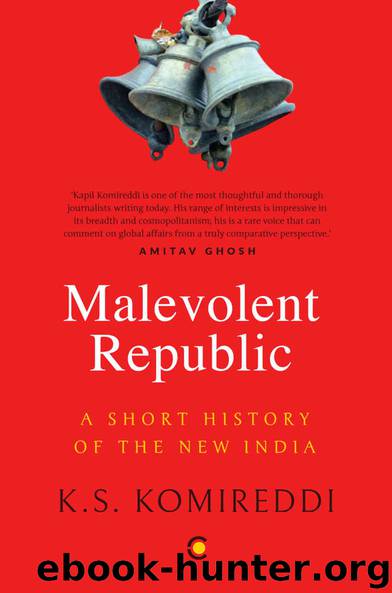
Author:Komireddi, KS [Komireddi, KS]
Language: eng
Format: epub
ISBN: 9789387894969
Publisher: Context
Published: 2019-05-29T21:00:00+00:00
7
Terror
If we do not know how to work properly and run an economy, at least we know how to fight properly.
—Slobodan Milosevic
On 28 September 2015, Mohammad Akhlaq, a fifty-year-old farm worker, was dragged out of his house in the town of Dadri, an hour’s drive from Delhi, by a crowd of young Hindu men apparently incensed by a rumour that he had slaughtered a calf. They killed Akhlaq by striking him repeatedly with bricks, beat his son to within a breath of his life, assaulted his elderly mother and attempted to molest his young daughter.1 Akhlaq’s forbears had settled in the village just before the subcontinent’s partition, rejecting, like millions of their co-religionists, the snare of Islamic Pakistan for equal citizenship of a secular state. Seven decades on, the state had a new master, and the young men who burst into Akhlaq’s house were enforcing his idea of what India ought to be. The new establishment did not mourn the dead man. It supplied alibis for his executioners.
India’s minister of culture, a local member of parliament, described the savagery as an ‘accident’. To the chief minister of the neighbouring state of Haryana, another Hindu nationalist, it all amounted to a ‘simple misunderstanding’. Top-tier leaders of the BJP issued posthumous condemnations of Akhlaq for wounding the feelings of Hindus by eating beef. Hindus should not be expected to ‘remain silent’ when a cow is killed, a parliamentarian in saffron robes told the press. He was ‘ready to kill and be killed’ for the cow.2 ‘When we hurt people’s sentiments,’ another leader explained, ‘such clashes take place.’ If the family consumed beef, the local legislator announced, ‘they are also responsible’ for what happened to them. The village should be left alone, demanded a party hierarch. ‘Fear has been generated with people being threatened with arrests,’ he complained, but Hindus were in no mood to ‘tolerate harassment’ by the authorities.3 They were in charge now. Their Great Leader, lost in deliberate isolation, did not utter a word.
The threat of a mass agitation by Hindu supremacists terrified the local administration—run by a secular party—which dispatched the police to seize the meat in the Akhlaq family’s refrigerator and send it away to a lab for tests to determine if it was beef. It was not. But the family could no longer live there. Akhlaq’s young son had to undergo two brain surgeries to survive. Journalists who covered his plight were pelted with stones by relatives of the men charged with his father’s killing. Akhlaq’s oldest son served in the Indian Air Force. His boss, the chief of India’s air force, had the family evacuated to a base. For decades they had coexisted happily with people of other faiths. On Eid, they sent packed meals to Hindu neighbours. They could not fathom why this happened. ‘We were completely taken by surprise,’ Akhlaq’s brother told the BBC. ‘Although it is true that we are the only Muslim family here, we have been living here for four generations and had never faced any issues before.
Download
This site does not store any files on its server. We only index and link to content provided by other sites. Please contact the content providers to delete copyright contents if any and email us, we'll remove relevant links or contents immediately.
| Africa | Americas |
| Arctic & Antarctica | Asia |
| Australia & Oceania | Europe |
| Middle East | Russia |
| United States | World |
| Ancient Civilizations | Military |
| Historical Study & Educational Resources |
The Sympathizer by Viet Thanh Nguyen(4446)
The Rape of Nanking by Iris Chang(4264)
World without end by Ken Follett(3512)
Ants Among Elephants by Sujatha Gidla(3495)
Blood and Sand by Alex Von Tunzelmann(3241)
Japanese Design by Patricia J. Graham(3218)
The Queen of Nothing by Holly Black(2658)
City of Djinns: a year in Delhi by William Dalrymple(2580)
India's Ancient Past by R.S. Sharma(2493)
Foreign Devils on the Silk Road: The Search for the Lost Treasures of Central Asia by Peter Hopkirk(2482)
Tokyo by Rob Goss(2464)
Inglorious Empire by Shashi Tharoor(2462)
In Order to Live: A North Korean Girl's Journey to Freedom by Yeonmi Park(2410)
Tokyo Geek's Guide: Manga, Anime, Gaming, Cosplay, Toys, Idols & More - The Ultimate Guide to Japan's Otaku Culture by Simone Gianni(2400)
India's biggest cover-up by Dhar Anuj(2381)
The Great Game: On Secret Service in High Asia by Peter Hopkirk(2373)
Goodbye Madame Butterfly(2288)
Batik by Rudolf Smend(2212)
Living Silence in Burma by Christina Fink(2093)
